

The Hondsrug-Hunzedal Complex as a result of fractures?
Since the nineteenth century, people have wondered how the Hondsrug-Hunzedal complex, simply called the Hondsrug, in Drenthe came to be. Recently (end of 2018), new information about the formation of the complex has been made available by TNO, which has made it possible to reconstruct the tectonic history of the area.
Its origin and a connection with the Neogene breaks of the Roerdal Slenk are likely.
To date, a glacial explanation is given that assumes that during the last glacial period, 200,000 years ago, the ice sheet experienced its maximum expansion in the Pleistocene along the Amsterdam-Prague line. From Scandinavia, it also expanded in a southwestward direction across Northern Netherlands, creating various subglacial landforms such as cliffs and valleys. The Hondsrug is almost perpendicular to the direction of movement of the ice sheet, but since it is not a cliff and the Hunzedal is not a valley, this does not fit into the glacial landscape (Figure 1).
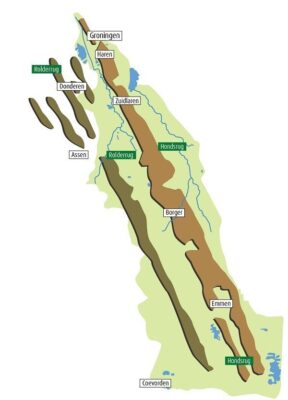
The 70 km long straight parallel cliff ridges, which can be up to 20 meters high, constitute an unknown element in the global subglacial world and are therefore not explainable as the result of ice movements. Attempts have been made to circumvent this problem by assuming that the land ice in the North Sea area made a large turn causing it to come from the north-northwest to create a glacier valley in Drenthe and from the cliff ridges so-called megaflutes, which are known nowhere in the world as having such a shape and length.
The proposed explanation is rather speculative and, in my opinion, does not provide a basis for the formation of the Hondsrug-Hunzedal complex; nevertheless, it is presented in numerous sources, beginning with Berg and Beets (1987), as credible. For geologists, a tectonic explanation from the very beginning was a real option, but it always ran into difficulties due to the lack of sufficient subsurface information due to a lack of drilling data and seismic surveys, so this could not be confirmed until today.